When Floods Occur: What Happens to the Soil?
Have you ever seen a farm field or soccer field turned into a shallow lake after a heavy rainstorm? Or perhaps you’ve seen or experienced flooding events that become news stories from around the world.
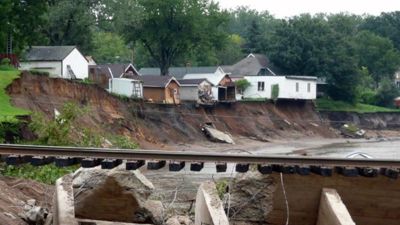
A mudslide (or landslide) consists of mud and other earth materials that fall down a slope, usually after a period of heavy rain. Credit: SSSA SoilsMatter blog
Flooding can occur in many places, not only in regions that receive little rainfall, but also in areas that typically receive ample rainfall when excessive amounts fall in a short period. Floods also occur at various scales, ranging from brief ponding in low-lying areas to widespread flooding at the field or landscape level following intense storms. And, it’s not just about the water; it can wash away plants, alter how soil breathes, disrupt nutrient cycles, and impact new growth long after the water has disappeared.
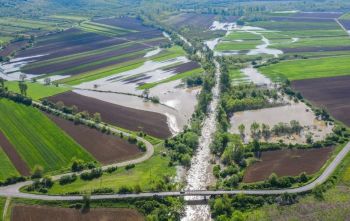
Aerial view of flooded fields. Credit: adobestock
In some flooding events, water does not immediately run off but instead pools on the soil surface and remains there for hours or even days. This standing water slowly disappears through infiltration into the soil, evaporation into the air, or drainage into nearby ditches and waterways. During larger or more intense floods, fast-moving water can overwhelm the soil’s ability to absorb moisture, leading to severe erosion, sediment movement, and even mudflows or mudslides on sloped land. These events occur because saturated soils lose their strength and structure, allowing soil particles to detach and move downslope more easily. Recovery after such flooding depends on the extent of soil loss. While shallow ponding may leave soils largely intact, large erosion events can remove decades of soil formation and require years of careful management to rebuild soil structure and fertility.
So What Happens Beneath the Water?
Healthy soil is made up of solid particles, organic matter, and a network of pore spaces that hold both air and water. When water covers the soil surface, the tiny air spaces that normally hold oxygen are filled with water instead. Without oxygen, plant roots begin to suffocate, and helpful soil organisms, those that recycle nutrients and build structure, slow down or die off. This condition, called anaerobiosis, often leads to nutrient loss because nitrogen changes form and escapes as a gas, and carbon, once stored in the soil, can be released into the air.
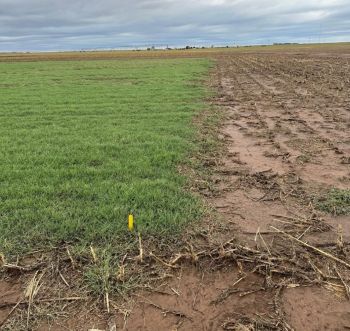
Topsoil erosion following a flooding event in the semi-arid Great Plains. Credit: Dotun Arije
In Clovis, New Mexico, an intense 2023 summer storm caused flooding in several wheat fields in Curry County. Within hours, the topsoil turned to mud, and wheat that was nearly ready for harvest was swept away. When the water finally drained, parts of the field were stripped bare, exposing lighter subsoil underneath, a clear sign that erosion had removed the most fertile soil layer. Vegetation makes a difference during high-velocity runoff- the grass-covered soil (left side of photo) held together and absorbed more water, while the bare field (right side of photo) lost topsoil and crop residue due to erosion.
Why Some Soils Survive Better Than Others
Not all soils respond the same way to flooding. In the Clovis, NM case described above, the floodwater slowed down where vegetation or grass cover was present, giving the soil time to absorb the moisture rather than lose it. Plant roots helped anchor the soil, reducing erosion and protecting organic matter from being washed away. In contrast, bare or recently tilled soils suffered the most damage, with gullies carving through the surface. Healthy, well-aggregated soils act like sponges, storing more water, resisting crusting, and recovering faster after storm events.
Topsoil erosion following a flooding event in the semi-arid Great Plains. High-velocity runoff removed the nutrient-rich surface layer, exposing the subsoil and damaging the wheat plants. Vegetation makes a difference – the grass-covered soil (left) held together and absorbed more water, while the bare field (right) lost topsoil and crop residue due to erosion. Picture credit: Author
Can Soils Recover?
Recovery is possible, but it depends on various factors, including the amount of soil lost and the rate at which vegetation returns. In farm fields, recovery depends on the extent of erosion and the rate at which crops or cover plants can regrow, and in some cases, farmers may replant damaged areas. When topsoil or even subsoil is washed away, farmers often add organic amendments to help restore soil structure, nutrients, and fertility.
In non-agricultural areas, such as grasslands, forests, lawns, or along streambanks, soil recovery relies mainly on natural vegetation. Plant roots help stabilize the soil, reduce further erosion, and slowly rebuild soil structure, while microbes contribute to nutrient cycling and aggregation. However, recovery in these systems can be slow, especially after severe flooding, because soil forms over very long periods. Practices such as minimizing disturbance, maintaining plant cover, and protecting vulnerable areas from repeated flooding can help soils recover more quickly across all landscapes.
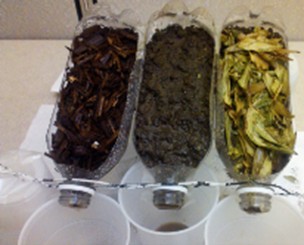
Credit: SSSA
Try This! Classroom Activity
SSSA has developed an activity on erosion - give it a try to demonstrate how vegetation/ground cover helps protect soil during rain.
Additional Reading:
Arije, D., Ghimire, R., Bista, P., Angadi, S. V., & Gard, C. C. (2024). Soil organic carbon recovery and soil health in semi-arid drylands with years of transition to perennial grasses. Journal of Arid Environments, 225, 105263.
Author: Dotun Nathaniel Arije, New Mexico State University, Agricultural Science Center at Clovis